Thursday, October 30, 2014

The major crops of the world such as tobacco, sugar, cotton, tea, the entire spectrum of spices, rubber, and coffee and chocolate have had myriad impacts on world culture in both social and economic manners when looked at through the most rudimentary lens. The impact of these crops however goes beyond just the social and economic layers of society; in fact, they are a foundation for society as a whole, contributing to the discovery of all corners of the Earth and the technological progress needed to accomplish such feats. However, before each new crop could be discovered in its native region and then mass cultivated and produced, explorers needed a means to discovery and cultivation, a means brought about by the plant and byproduct most influential on world history: wood.
Timber
http://www.photo-dictionary.com/photofiles/list/9714/13188timber_pile.jpg
            Before technology, wood served as a fuel source for man, burnt for warmth and preparing food beneath their shelters constructed of timber. This use of wood lies at the heart of the human ability to survive and it has been maintained (and over-harvested) in our species’ history as a primary resource for continued life in all regions of the world. Beyond being used as a fuel for fire (which encompasses endless uses within itself) wood and trees have been used structurally since the beginning of time in both transportation and shelter needs. Without the wooden ships that brought Europeans to the far-East and also the New World, all of the aforementioned crops would not have been cultivated and produced in the way we know them today. This also includes the entire populations of enslaved peoples brought to the New World for cultivation of all of such crops and other appalling “uses.”
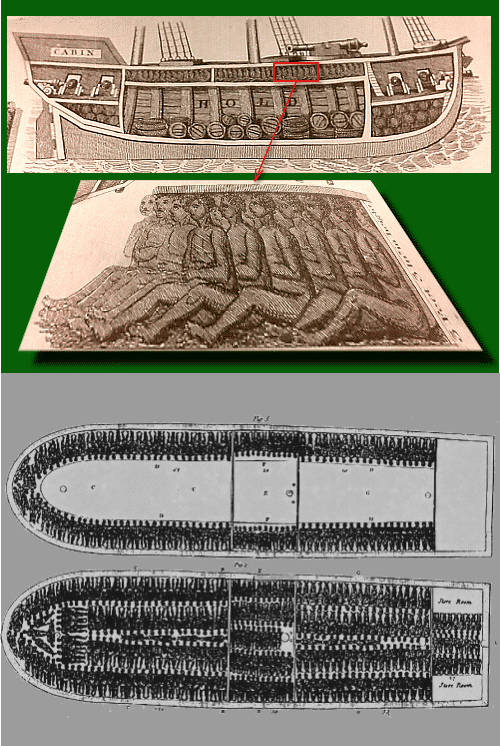
Slave Ship
 http://upload.wikimedia.org/wikipedia/commons/4/4d/NavioNegreiro.gif
Basic technologies such as baskets and hunting and gathering tools constructed from wood contributed to the commencement of the Neolithic Revolution, the basis of all agriculture in the modern world. With agriculture came the need for increased production and therefore technology such as plows and mills--constructed from wood--to supply entire societies with food and a wholesome livelihood in general. The paper used from wood and used as money in its earliest uses still serves as nearly the entire basis of functioning societies and economies today. Likewise, the transfer of information through written literature and scientific report now serves as the entire basis of the world’s collections of knowledge and data. Beyond these crucial uses that have molded society into its modern form, wood has also contributed to ceremonial purposes and also a building material for the weapons that paved the way for world discovery and the annihilation of entire cultures. It is used medicinally and in sport as well. The list goes on.
Written Notes of Leonardo Da Vinci
http://www.leonardo-da-vinci-biography.com/images/leonardo-da-vinci-anatomy.4.jpg

Trees and the wood produced from them are the foundation of society’s most influential factors today. The production of crops that developed the world was not possible without wooden resources. Without wood life as we know it in the modern day simply would not exist, and it is clear that beyond their ecological functions, trees and wood have had the greatest impact on world history.

Saturday, October 11, 2014

           The British Empire played an immense if not the largest role in the development of Global Westward and Eastward exploration, discovery, and development. This was accomplished largely in part due to the merciless and all powerful East India Trade Company (EIC). This nationally funded agent of imperialism acted as the boots on the ground and catalyst for opening up major passageways of trade and colonial expansion on the global stage, and the major contributing factors to this are the cultivation and consumption of cotton, tea, and opium.
Cotton Crop in India
http://www.thehindubusinessline.com/multimedia/dynamic/01348/BL01_AGRI_COTTON_-_1348276f.jpg
            The EIC held a forceful monopoly over most of Southeast Asia at the peak of their prosperity due to their successful efforts with cotton cultivation in India. They nearly conquered entire cultures and manipulated indigenous peoples into labor by the masses while taking advantage of the rich and fertile soil of the region that was prime for cotton crop growth. The huge English demand for cotton as well as industrial and technological progress taking place at the time sent the cotton back to the mills of England, thereby funding the EIC and providing for further growth.
http://gibaulthistory.files.wordpress.com/2011/02/british-opium-sales-to-china.jpg
            This led to satisfying the growing demand for tea in England, a feat made possible by trade relations with China. The Chinese at the start of this trade industry refused trade with Westerners however and would strictly accept silver and gold as payment, no other goods.
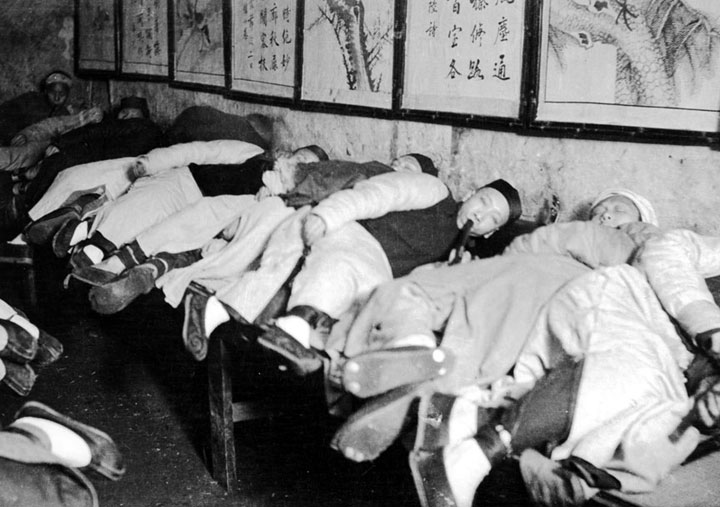
Shanghai Opium Den, 1907
http://www.china-mike.com/wp-content/uploads/2011/02/2-opium-den-in-shanghai-1907.jpg

            Through clever (scheming) logistics, the EIC established firm opium cultivation in Bengal by the hand of a man named Warren Hastings, a prominent English statesman. Along with EIC, he colonized the Bengalese region and began shipping out vast amounts of the highly addictive plant (when consumed via drinking or smoking) to China. The Chinese became hooked on consumption of the substance and as a result, allowed opium as opposed to silver for the tea trade, thereby quenching the overwhelming thirst for tea in England. 
Tea in its various forms
http://upload.wikimedia.org/wikipedia/commons/0/04/Tea_in_different_grade_of_fermentation.jpg

Tuesday, October 7, 2014

Beginning with the Neolithic Revolution, the consumption of beer and other drinks produced from wheat and barley reigned prolific throughout world-wide cultures. Since nearly 6000 BCE, many societies heavily consumed beer and other related beverages and it fueled social and economic growth. But before any of this change came about, the process in which beer is produced through wheat and barley cultivation began to develop.
Barley Plant
http://www.organicsansar.com/uploads/8/7/9/3/8793897/2252863_orig.jpg

 Discovered by accident, fermentation was a process realized by humans of hunter-gatherer lifestyles when grain was left out in moist environments for extended periods of time. Once the necessary steps required to brew this early form of beer were discovered and taste for the beverage grew, these hunter-gatherers began to cultivate grain on a larger scale.
Development of Agricultural Lifestyles
http://globalfoodpolitics.files.wordpress.com/2013/05/agricultural_revolution.jpg
Prior to the cultivation of barley, the Earth’s Last Glacial Maximum occurred; this was a period in which the ice covering the Earth’s surface between 24,500 and 17,000 BC reached its peak. With the melting of continental regions of ice, a period known as the Younger Dryas, or a consistent cold period after the ice melted, began. The collapse of the American ice sheets is believed to be a major contributing factor to this “cold spell.” With a difficult climate for the wheat and other grains and cereals to grow in, the hunter-gatherers needed to store seeds to protect the longevity of their crops. With this, the earliest forms of agrarian societies began to develop.
Cereal Crop
http://s3.freefoto.com/images/07/55/07_55_2_web.jpg
With agriculture, certain crops such as cereals, pulses (lentils), and also flax were domesticated and specialized roles in society began to emerge. This created structure for civilizations as well as a sustainable food and living source. With the shift from nomadic lifestyles stemming from wheat and barley cultivation involved with beer, social and technological progress was brought about on a vast scale. This eventually incentivized world exploration and colonial expansion.


Today beer is consumed worldwide as a social, recreational, and tasteful beverage among all socioeconomic classes in developed and developing countries. It is a major industry leading back to the earliest forms of society, having contributed to the development of world cultures.

Saturday, September 20, 2014

               Today, spices are seen as average household commodities of basic value, purchasable at your nearest local supermarket. The path taken by most common spices to reach the common use that they hold today is that of simultaneous cultural expansion and loss as well as global development. Spices today however are due a great amount of appreciation in that they fueled major European colonial endeavors, in turn altering the course of world history.

In “ancient times,” anything with a strong aroma could be considered a spice. It was the European desire to control the trade and use of this valuable commodity however that led to the development and classification of the various spices known today. Starting with the Crusades (1095-1275), the spice market was opened up and expanded into Europe in large scale for the first time.

The European monarchies and governing bodies sought religious and colonial expansion and as such, explorers such as Portuguese navigator Dom Vasco da Gama sailed eastward into uncharted regions of the globe. What they discovered and developed contributed the shaping of world history. The spices found in India as well as the Moluccas and current day Sri Lanka in the Age of Discovery brought about European governing bodies promoted further world exploration and colonial expansion while also spreading the goods that were spices (pepper, nutmeg, cloves cinnamon, etc.) from continent to continent.
Vasco da Gama
biography.com 
Intercontinental trade markets formed and prospered and the European aristocracy and wealth behind the various countries’ desire to control the spice trade brought about huge pools of financial security for governments but also a myriad of human and cultural conflict. Entire indigenous populations in the Moluccas were wiped from existence as the powerful European governments traded weapons and hard goods to tribes in civil conflict for access to spices. In addition to the fueling of wars, explorers such as the Dutch and British East India Company in the early 17th century exterminated entire local populations to gain control of the world-sought spices and control of their trade.
European Spice Trade
http://www.iro.umontreal.ca/~vaucher/Genealogy/Documents/Asia/EuropeanExploration.html

The European monarchies and governing bodies that pushed eastward in search of spices and dominance in their trade altered the course of world history in that they colonized and discovered entirely untouched civilizations, lands, and cultures. World economies developed, but at the cost of vast cultural loss and human life.    
World Wide Spice Accumulation
http://www.getrichslowly.org/blog/2010/03/27/what-do-ancient-spice-traders-and-the-modern-financial-industry-have-in-common/

Saturday, September 6, 2014

Tobacco and Cotton were two founder crops of the United States of America.  Explain how and why, highlighting any connections / similarities between the crops.


Both the tobacco and cotton crop were essential to the founding of independent colonies in the western world that would become the United States of America. The two crops could grow profusely in the warm, temporal climate of eastern North America and as a result, Britain found itself in a time of major colonial expansion. As major trade markets opened up in Europe and Asia, tobacco and cotton spread across the world, consumed in an enormous variety of fashions. 

Photo credit: Paul Owen 2012
When colonist John Rolfe arrived at the hell that was the Jamestown settlement, the British Empire was on the verge of abandoning and losing the settlement due to the impact of famine and disease. Rolfe’s work on the cultivation of tobacco crops began in the ideal climate and environment of the settlement lands and the colony prospered.

Jamestown Settlement, early 17th Century
Photo Credit: Nasa.gov
The tobacco crop allowed the colonists to persevere through the initial winters and move out of the terrible existing living conditions and into a thriving effort of imperialism that brought thousands of new settlers and eventually, horrifyingly enough, slavery.
Tobacco Crops
Photo Credit: LearnNc.org
Similarly synonymous with the evils of slavery in the United States’ development is the cotton crop. Like tobacco, cotton was a widely popular and highly useful good around the world and as such there was a very high global demand. With the foundation that tobacco laid for society in the Western World, cotton provided economic and material resources for the expansion of the American settlements. This exposed an appalling cycle that led to the growth and prosperity of the tobacco and cotton industry in which slave labor was used as a manner of production of the crops as well as a currency to acquire goods and further common assets. This boosted an entire economy which in turn provided autonomy and self sustaining resources for the founding of the United States of America.
Photo Credit: Slave Breeding in The US, Wikipedia
Tobacco and cotton’s widespread popularity and global consumption in the 17th and 18th century provided financial stability to Britain’s endeavor in colonizing the Western World and as such, the American colonies saw continuous backing from the British Empire and prospered exponentially. This led to a mentality of independence among the colonists and with the mismanaged tariffs, taxes, and legislation imposed on  the colonies by the British government, the settlers were on the path to American independence. The tobacco and cotton crops were only players in the full development of the United States, but the usefulness and resilience of the colonists brought about by the two crops are what allowed for such a monumental expansion of a new, independent society.